
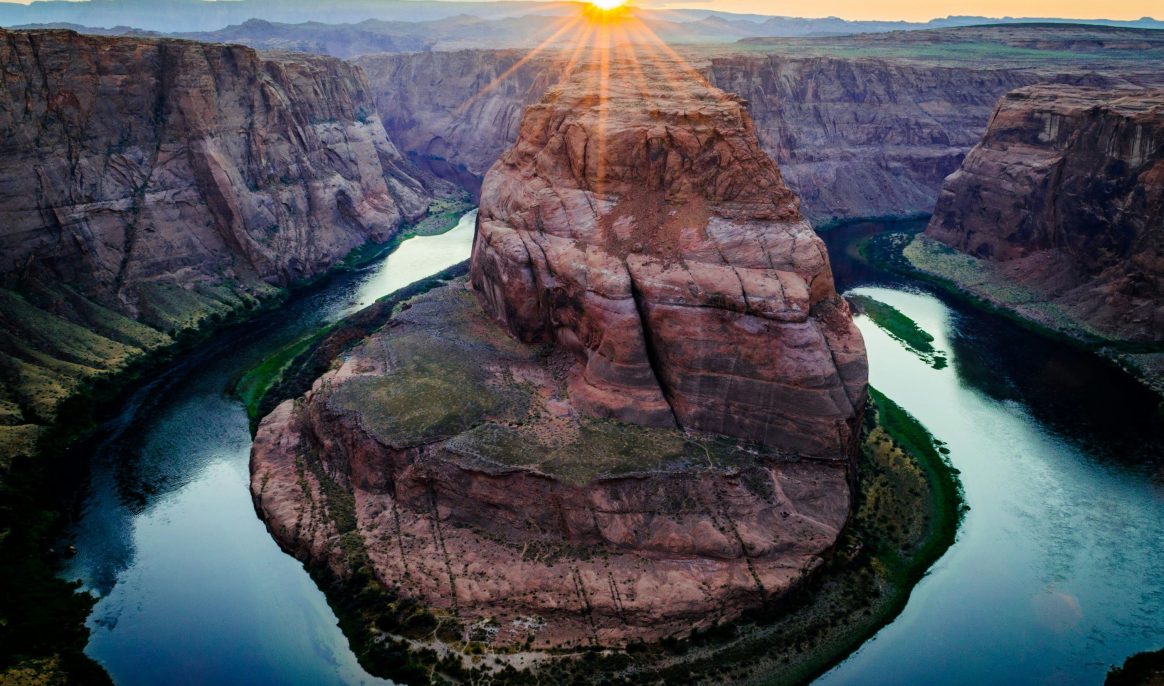
©Tom Gainor via Unsplash - photo d'illustration du Colorado (fleuve)
-
Sep 13, 2026 12:00
The Colorado River Basin is facing serious water supply problems due to a persistent drought, with repercussions for the economy and environment of no less than seven states in the western United States.
The Colorado River, one of North America's major river arteries, is dangerously close to breaking point. After years of fruitless negotiations between the seven states that depend on its basin, the US federal government has decided to intervene directly with a new emergency plan. This could lead to drastic cuts in water resources for cities, agriculture and business, particularly in Arizona.
This announcement comes after the failure of an agreement between Arizona, California, Nevada, Colorado, Utah, Wyoming and New Mexico on the management of the river beyond 2026, when the current rules for operating the large artificial reservoirs of Lake Mead and Lake Powell expire.
For over 40 million people, the Colorado River is a vital source of drinking water, irrigation and hydroelectric power. But decades of overexploitation, rampant urbanization, intensive agriculture and climate disruption have gradually dried up the system.
Over the past twenty years, the basin has been hit by an unprecedented "mega-drought", exacerbated by the rise in water levels and temperatures as well as reduced snowfall in the Rocky Mountains, on which much of the river's flow depends. Levels in Lake Mead and Lake Powell, the system's two main reservoirs, remain close to critical thresholds.
According to a memo from the Bureau of Reclamation, the federal agency that manages Colorado's water system, inflows to Lake Powell have already fallen by around 1.5 million acre-feet (or 1.85 billion cubic meters) since the beginning of 2026. The situation jeopardizes not only the water supply, but hydroelectric power generation as well.
The federal plan
In the face of the political impasse, Washington is working on a new ten-year operating plan involving mandatory cuts in water deliveries, re-evaluated every two years according to reservoir levels.
According to early indications, the cuts could amount to as much as 40% of the volumes currently supplied to the Lower Basin states of Arizona, California and Nevada, with an overall reduction of up to 3 million acre-feet per year (around 3.7 billion cubic meters), equivalent to the annual consumption of 6 to 9 million homes. Arizona is likely to be the hardest-hit state. The Central Arizona Project (CAP), the gigantic canal that carries water from Colorado to Phoenix and Tucson, could be cut back so severely that part of the water supply would be completely interrupted during the worst years.
The dispute centers on the division of responsibilities. The Lower Basin states accuse the Upper Basin states - Colorado, Utah, Wyoming and New Mexico - of not wanting to contribute enough to the reduction efforts. The Upper Basin states, meanwhile, argue that California, Arizona and Nevada have for decades been consuming more water than the river can actually supply.
Just a few weeks ago, Arizona, California and Nevada presented an alternative proposal based on voluntary reductions until 2028, with an estimated saving of over 3.2 million acre-feet (around 3.9 billion cubic meters). However, it remains to be seen whether the federal government will accept this solution or impose its own autonomous, more binding plan.
The Colorado crisis is now seen as one of the most striking examples of how the climate crisis is putting pressure on water systems worldwide. According to many experts, the problem is no longer just one of temporary drought, but of a structural process of "aridification" in the southwestern United States: higher temperatures mean more evaporation, less snowpack and therefore less water available during the summer months.
And while states argue over quotas, time is running out. The Bureau of Reclamation is expected to announce the next steps by summer, but one thing is now clear: the water management model developed in the last century is no longer viable in a changing climate.
Share: