
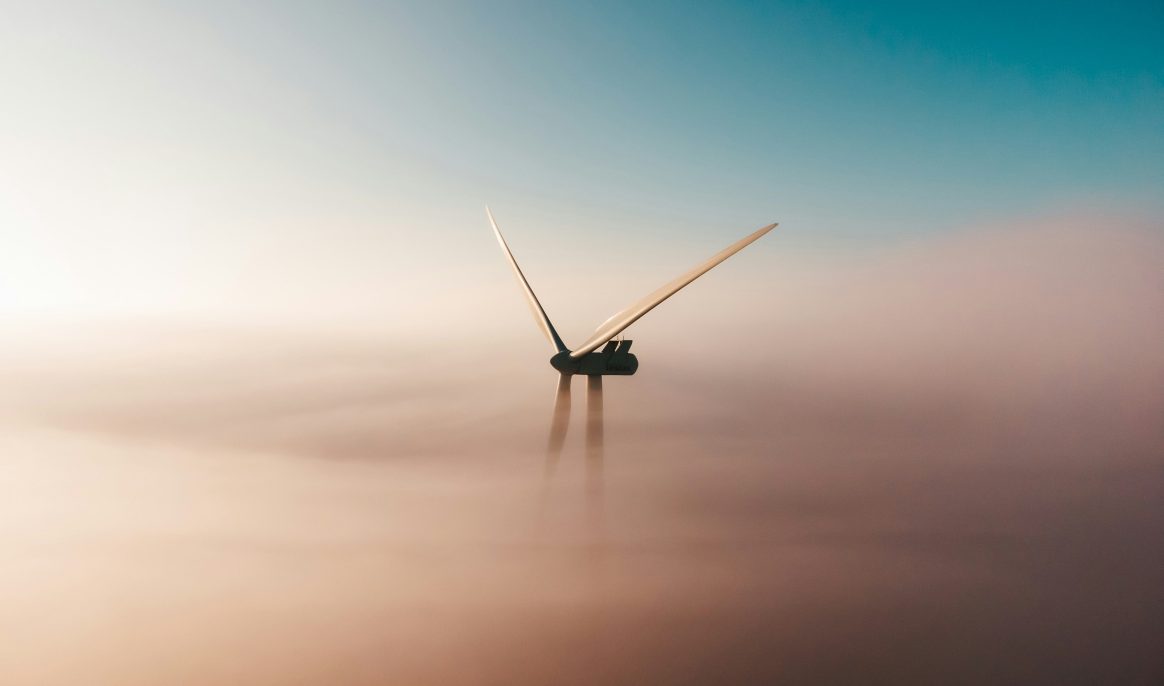
©Sander Weeteling via Unsplash - photo d'illustration d'une éolienne
-
Jun 12, 2026 12:09
No lithium, no invasive mining: a technology based on compressed air and salt caverns promises to revolutionize renewable energy storage.
For years, we have associated the idea of energy storage with lithium batteries. An effective solution, but one not without environmental, economic, and geopolitical contradictions. Today, as renewable energy production grows faster than grid infrastructure, an alternative is taking shape. It seems straight out of a basic physics textbook: using air to store energy by harnessing vast natural salt caverns underground.
This is neither a futuristic technology nor a laboratory experiment. It is a concrete system, already under development, that could solve one of the most challenging problems of the energy transition: what to do with clean energy when there is too much of it, and how to make it available when it is truly needed.
How compressed air storage works in salt caverns
The mechanism is surprisingly simple. When wind and solar power plants generate more electricity than the grid can absorb, this energy is not wasted. It is used to compress air and push it deep into large underground cavities carved out of salt. Water plays a fundamental role here: it keeps the pressure stable, making the system more efficient and safer.
As soon as energy demand rises, the compressed air is released; it rises through the water and drives turbines that generate electricity. No combustion, no chemical reactions, no rare materials: just a physical cycle capable of repeating itself thousands of times without significant loss of performance.
The real game-changer compared to traditional batteries is time. This type of storage isn’t designed to cover just a few hours, but long periods, lasting up to several weeks or months. It thus becomes a strategic reserve during times when the sun and wind are scarce.
The first major project in Germany
The transition from theory to practice is currently underway in Germany, where the first large-scale commercial installation based on this principle is planned. The company Augwind Energy is developing this project with the goal of bringing the system online between 2027 and 2028, with a storage capacity in the order of gigawatt-hours.
The choice of Germany is no accident. The country’s subsurface contains numerous salt caverns previously used for gas storage: naturally stable, impermeable structures suitable for repurposing without further land development. A geological resource that is being transformed into energy infrastructure, while reducing the costs associated with strengthening the power grid.
From an environmental standpoint, the comparison with lithium is clear-cut. Here, there is no need for mines, no toxic waste, and no dependence on critical supply chains. The expected lifespan of the facilities exceeds twenty-five years, with minimal degradation and limited maintenance. This represents a shift in perspective that moves the focus of energy storage from chemistry to physics, and from material scarcity to natural availability.
If the project delivers on its promises, the emerging scenario is one of cities powered in part by invisible reserves of clean energy. Reserves hidden underground, ready to take over when renewable energy isn’t enough. A simple, almost elementary idea that could prove to be one of the most solid keys to making our energy system truly sustainable.
Source: Augwind Energy
Share: