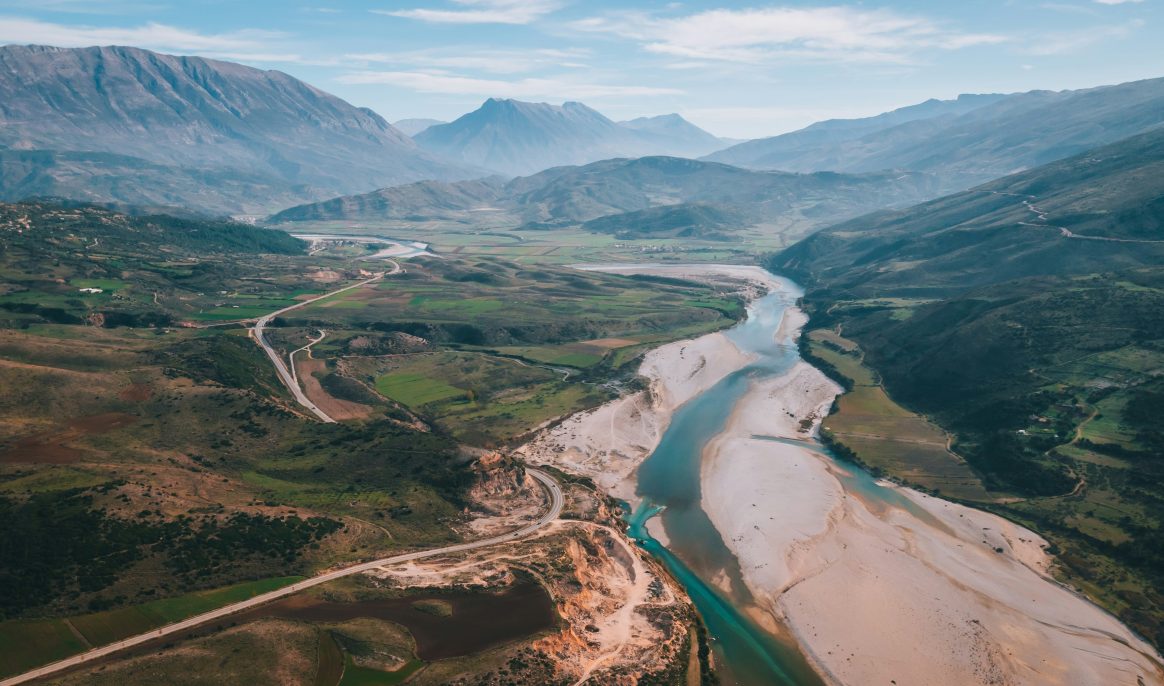
©Nicolas Jehly via Unsplash - photo d'illustration du fleuve Vjosa en Albanie
-
Jun 09, 2026 07:33
As Albania relies more and more on luxury tourism as an economic driver, protests are growing against one of the most controversial projects of recent years: the mega-hotel complex linked to Jared Kushner, American businessman and son-in-law of U.S. President Donald Trump, planned for the protected area of Vjosa-Narta and the island of Sazan.
The affair, which combines accusations of environmental destruction, contested legislative changes, repression of demonstrations and an investigation by the Albanian anti-corruption prosecutor's office, is taking on an international dimension. It affects one of the most precious natural areas in the Balkans, and comes at a time when Albania is pursuing its process of rapprochement with the European Union.
According to environmental organizations, construction machinery has been operating since late April inside the Pishë Poro-Narta protected area, part of the Vjosa-Narta protected landscape, one of Europe's most ecologically important coastal areas. More than 70 endangered species and over 200 bird species, including flamingos and the curly pelican, find refuge here. The region also lies along the Adriatic Flyway, one of the main migratory routes between Africa and Europe.
In addition, the surrounding waters are home to one of the last populations of Mediterranean monk seals, one of the world's most endangered marine mammals, as well as important nesting sites for the loggerhead sea turtle (Caretta caretta).
According to the Albanian environmental association PPNEA, BirdLife International's local partner, the current events represent "the worst episode of destruction ever recorded in an Albanian protected area". Reports indicate that work has been carried out without full permits, without a definitive environmental impact assessment, and even before final approval of the tourism project.
Damage already reported includes the dumping of gravel on ancient sand dunes protected by Albanian law, and the obstruction of one of the two natural channels linking the Narta lagoon to the Adriatic Sea. In concrete terms, blocking the natural exchange of water risks compromising the entire food chain of the lagoon ecosystem, with serious consequences for fish, birds and local biodiversity. Some of the damage caused could take hundreds of years to repair.
Investigation by the Anti-Corruption Prosecutor's Office
The intervention of Spak, the Albanian Special Anti-Corruption Prosecutor's Office, makes the case even more delicate. This body has confirmed the opening of an investigation into the changes made in 2024 to the regulations governing protected areas and land ownership rights. It is precisely these reforms that would have paved the way for tourism development in areas that, until recently, enjoyed much stricter protection.
The investigation aims to shed light on the legitimacy of the decisions that enabled the real estate project to go ahead.
Demonstrations and barbed wire on the beach
Tension escalated at the end of May when high fences topped with barbed wire were erected in the Zvernec area, preventing residents and tourists alike from gaining free access to the beach. Images of the fences fueled the anger of the local population and environmental organizations, who staged demonstrations both on site and in the capital, Tirana.
Environmentalists also denounced episodes of repression against demonstrators and called for guarantees of the right to peaceful protest.
Meanwhile, Albania's Prime Minister Edi Rama denied that the project concerned a protected nature reserve and said that the final proposal had not yet been formally presented. He also claimed that the environmental impact study had not yet been completed, and rejected accusations of environmental violations.
BirdLife Europe called on the European Commission to intervene, pointing out that the destruction of protected habitats, the repression ofpressure on peaceful demonstrations and the dissemination of disputed information in Parliament are incompatible with the criteria required of a candidate country.
The case of Vjosa-Narta today represents much more than a local controversy: it is the symbol of the tug-of-war between biodiversity protection and intensive tourism development, an issue that is affecting more and more areas in the Mediterranean.
Share: